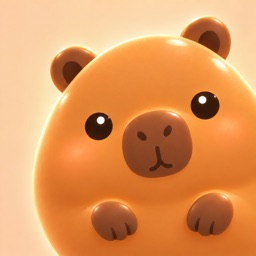
 Jellybara
Jelly notes
How to See Softness on Screen
Watch the edge of a pressed cheek, the nose that stays put, and the last wobble after release. Three small details give an on-screen character its squish.
Imagine pressing your thumb into a little foam ball. Even with your eyes closed, you have something to go on. Your thumb might sink in easily at first, then meet a gentle push back. Now picture the same press filmed from the side. What catches your eye might be the edge of the ball bulging beside the thumb. Your hand and your eyes have two different views of the same squeeze.
An on-screen squishy has edges worth watching, too. If you usually look at the middle of the character’s face, try following the outline a little way from the fingertip. Which part moves? Which part holds its ground?
Look beside the thumb during a press
A finger on a round cheek covers the very spot it touches. Yet if the curve below the cheek spreads, or the gap between the chin and the floor narrows, you can picture how far the finger has sunk. Imagine a face keeping exactly the same expression while growing just a little wider. That small change can give the cheek a sense of thickness.
Try pausing a video before and during a press. Compare the width of the patch touching the floor. A change you missed while watching the finger might be easy to spot down at the character’s feet.
Watch what stays put during a stretch
Picture pulling one cheek sideways. Imagine placing one dot on the tip of the cheek and another on the nose. If both dots travel the same distance, the whole face seems to follow your hand. If the nose mostly stays put while the cheek travels, the gap between the dots grows. That widening space is where you see the stretch.
On a second viewing, keep your eyes on the nose. The first time you might have noticed how far the cheek went. This time you might see how much of the face was drawn into the movement.
Stay for the last beat after release
Once you let go, the hand and the character can move independently. If the hand has stopped and a dent lingers, your eye waits there. If the tip of the cheek wobbles once more after reaching its usual outline, the very same press has a bouncy finish. Picture those two rhythms in turn. You can also watch what happens after release with a physical squishy. Slow-Rise Squishies: Watching the Way Back
The Jellybara game page introduces pressing and stretching the capybara and includes a preview. When you watch the footage or play in the app, follow the tip of the cheek once, then the bottom of the body. Two people might watch the same gesture and pick different favorites. One might like how far the cheek follows the finger. The other might wait for a little wobble after release. Remember where your eye lingered, and “squishy” starts to describe a moment of your own.